Multilingual Typing Mastery: WPM Test Guide for Multiple Languages
Do you find your typing speed drops dramatically when you switch from English to Spanish, or from your native language to code? If you're one of the millions of people who regularly type in multiple languages, you know the struggle. Switching between different scripts, like from Latin to Cyrillic or adding accents in French, presents unique challenges to your muscle memory.
This guide is here to help. We'll explore practical techniques to adapt your finger placement and build new muscle memory for various keyboard layouts. By the end, you'll have a clear path to maintaining high speed and accuracy, no matter which language you're typing in. Ready to become a true multilingual typist? A great first step is to establish your baseline by taking a quick WPM test.
Mastering WPM Tests Across Different Languages
Before you can master typing in multiple languages, you need to understand the field you're playing on. Keyboards are not one-size-fits-all. They are adapted for the specific needs of each language, from common characters to unique scripts. Recognizing these differences is the first step toward conquering them.
QWERTY Variations and Language-Specific Characters
The QWERTY layout is the most common, but it's not always the same. Many languages use a variation of QWERTY to accommodate special characters. For example, the German layout swaps the 'Z' and 'Y' keys (becoming QWERTZ) because 'Z' is more common in German. French uses the AZERTY layout to provide easier access to accented letters like 'é' and 'à'.
For typists using languages like Spanish, Portuguese, or Vietnamese, the core layout is often QWERTY. The challenge comes from adding accents and diacritics. This usually requires using a combination of keys, such as an 'Alt' or 'Option' key plus a letter. Learning these combinations is crucial for maintaining a smooth typing rhythm without constantly pausing to find the right character.
Non-Latin Scripts: From Cyrillic to Arabic to Chinese Input Methods
Moving beyond the Latin alphabet introduces a whole new level of complexity. Languages that use non-Latin scripts have entirely different keyboard layouts designed to match their character sets.
- Cyrillic: Used for languages like Russian and Ukrainian, the Cyrillic layout maps its unique characters (e.g., Й, Ц, У, К, Е, Н) to the keyboard. For a touch typist, this requires learning a completely new home row and finger mapping.
- Arabic: The Arabic keyboard is designed for its script, which is written from right to left. The keys are arranged based on character frequency and shape, which is a significant change from the QWERTY system.
- Chinese/Japanese/Korean (CJK): These languages use Input Method Editors (IMEs). Instead of one key per character, you type the phonetic sound (like Pinyin for Chinese or Romaji for Japanese). The IME then presents a list of characters to choose from. This makes typing less about finger placement and more about phonetic knowledge and quick selection.
Understanding these fundamental differences is key. It helps you appreciate that slowing down is a natural part of learning a new layout and sets the stage for targeted practice.
Finger Placement Adaptation for Improved Typing Tests
Once you understand the layout, the real work begins: retraining your fingers. Your brain has built strong neural pathways for your primary language's keyboard. The goal is to create new pathways for other languages without erasing the old ones. This is all about conscious practice and building new muscle memory.
Building New Muscle Memory for Accented Characters
For those typing in languages with accents, speed often suffers because you have to break your flow to input a special character. The solution is to turn this two-step process into a single, fluid motion.
Start by isolating the most common accented characters in your target language. For instance, if you're learning French, focus on 'é', 'è', 'ç', and 'à'. Dedicate practice sessions to typing words that contain these characters repeatedly. Instead of thinking "press Option+e, then press e again," practice until your fingers perform the action automatically. This deliberate drill will soon become second nature, just like capitalizing a letter with the Shift key. You can test your progress with texts that feature these characters.
Position Shifts for Non-Latin Keyboards
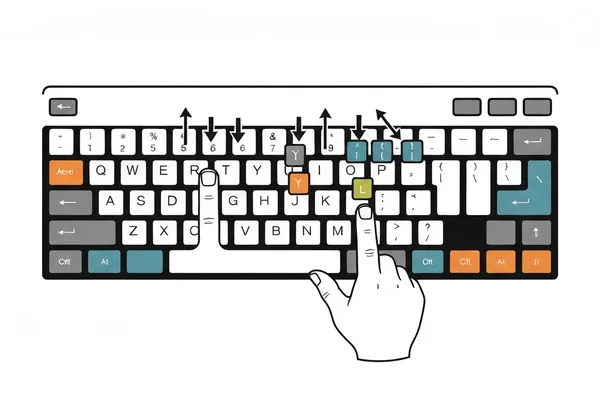
When learning a completely new layout like Cyrillic, you must go back to the basics of touch typing. Think of it as learning to type for the first time. Print out a map of the new keyboard layout and place it beside your monitor.
- Find the Home Row: Identify the home row keys for the new layout and practice resting your fingers there.
- Practice Finger Reaches: Slowly practice reaching for the other keys from the home row position. Say the letter out loud as you press the key to reinforce the connection in your brain.
- Start with Simple Words: Begin by typing simple, common words in the new language. Focus on accuracy, not speed. Speed will come naturally as your muscle memory develops.
This process requires patience. Your initial WPM will be low, but consistent practice is the only way to build the foundation for future speed.
Language-Specific Typing Practice Strategies
Theory is useful, but progress comes from practice. To become a proficient multilingual typist, you need a training plan that targets your specific challenges. This means moving beyond generic typing drills and focusing on the unique vocabulary and character sets of your target language. You'll need to find or create practice materials that specifically address those challenges. Avoid one-size-fits-all approaches that may not prepare you for the actual typing demands you'll face.
Customizing WPM Test for Language-Specific Drills
One of the most effective ways to improve is to practice with relevant material. Generic English paragraphs won't help you master Russian grammar or Spanish accents. This is where a customizable tool becomes invaluable.
Using a platform like WPMTest.cc, you can use the custom text feature for targeted drills. Find an article, a book chapter, or even a list of common words in your target language and paste it into the test field. This allows you to:
- Practice high-frequency words: Improve your speed on the words you'll use most often.
- Drill specific characters: Focus on texts rich in the accented or unique characters you find difficult.
- Simulate real-world tasks: Practice typing content related to your work or studies.
By customizing your practice, you make every session more efficient. You can take a customized typing test right now to see how it works.
Common Multilingual Typing Mistakes and Corrections
When learning, everyone makes mistakes. Recognizing common pitfalls can help you correct them faster.
- Mistake 1: Reverting to Old Habits: Your fingers might automatically type the QWERTY equivalent of a key on a different layout.
- Correction: Slow down. Consciously focus on each keystroke. Accuracy must be your priority over speed in the beginning.
- Mistake 2: Looking at the Keyboard: This is a major barrier to building muscle memory.
- Correction: Force yourself to not look down. It will be slow and frustrating at first, but it's the only way to learn touch typing in a new layout.
- Mistake 3: Forgetting to Switch Input Methods: Accidentally typing in the wrong language is a common and disruptive error.
- Correction: Pay attention to the language indicator on your screen. Practice the keyboard shortcut for switching languages (e.g., Alt+Shift or Win+Space on Windows) until it becomes a reflex.
Regularly assessing your performance on a typing speed test will help you identify which mistakes you're making most often, allowing you to focus your efforts.
Tools and Resources for Multilingual Typists
Beyond practice, having the right setup can make a significant difference in your multilingual typing journey. From software that smooths the transition between languages to hardware designed for polyglots, these tools can streamline your workflow and reduce friction.
Keyboard Software Solutions for Language Switching
Your computer's operating system has built-in features for managing multiple languages, but dedicated software can offer a more seamless experience. Tools like AutoHotkey (on Windows) or Karabiner-Elements (on macOS) allow you to create custom shortcuts and remap keys.
For example, you could program a specific key to instantly switch to your second language layout and back again. You could also create macros for typing frequently used but complex accented characters. These small optimizations reduce the mental load of switching contexts, allowing you to stay in your typing flow. The key is to find a system that feels intuitive to you and stick with it.
Physical Keyboard Options for Multilingual Typing
For those who are serious about multilingual efficiency, investing in physical hardware might be a good option. There are several types of keyboards designed for multilingual users:
- Keyboards with Printed Dual Legends: Some keyboards come with the characters for two languages printed on the keys (e.g., English and Arabic, or English and Cyrillic). This can be a helpful visual aid, especially when you are just starting out.
- Customizable Mechanical Keyboards: Many mechanical keyboards allow you to physically swap out the keycaps. You can create a layout that perfectly matches your needs or even color-code keys for different languages.
- Ergonomic Keyboards: While not language-specific, an ergonomic keyboard can reduce strain during long practice sessions. This is crucial when you are building new muscle memory.
Ultimately, the best tool is the one that helps you practice consistently and comfortably.

Your Journey to Multilingual Typing Proficiency
Becoming a master of multilingual typing doesn't require any secret shortcuts—it comes from dedicated, focused practice over time. It requires patience to unlearn old habits and dedication to build new ones. By understanding different keyboard layouts, adapting your finger placement, and using targeted practice strategies, you can achieve fluency and speed in every language you use.
The key takeaways are simple: start with the fundamentals, prioritize accuracy over speed, and use the right tools for the job. Remember that your WPM will naturally dip when learning a new layout, but it will climb back up with persistent effort.
Are you ready to begin your journey? The best way to start is by measuring your current skill. Go to WPMTest.cc now, paste in a text from your target language, and see where you stand. Track your progress, celebrate small victories, and watch as you transform into a confident multilingual typist.
FAQ Section
What is a good WPM score for typing in multiple languages?
A "good" WPM score is relative. While an average English typist might aim for 40-50 WPM, your score in a second language will likely be lower initially. A good goal is to first achieve 95% or higher accuracy, regardless of speed. As you build muscle memory, your WPM will naturally increase. A proficient multilingual typist might have different but stable speeds for each language.
How can I maintain my typing speed when switching between languages?
The key is practice and a smooth workflow. Use keyboard shortcuts to switch input sources instantly. Practice switching between languages during your typing drills to make the transition a reflex. The more you do it, the less your brain will "lag" when changing contexts, helping you maintain a consistent rhythm.
What's the best way to practice typing in a non-Latin script?
The most effective method is to treat it like learning touch typing from scratch. Focus on the home row first, then gradually expand to other keys. Use a customizable tool to practice with common words and simple sentences from that language. For instance, you can find a Russian news article and use it on the WPM Test online to get real-world practice.
Does using multiple keyboard layouts decrease overall typing efficiency?
Initially, yes. Your brain needs time to build and access different sets of muscle memory, and you might mix them up at first. However, in the long run, it does not decrease efficiency. With enough practice, your brain becomes adept at "code-switching" between layouts. You can become highly proficient in all of them without a significant loss in speed.