WPM Accuracy Under Pressure: Stress-Testing Techniques
Have you ever felt like a master typist while practicing alone, only to have your fingers freeze during an important exam or a live presentation? It's a common frustration. You might achieve a high score in a relaxed setting, but the moment a timer starts or a supervisor watches, your accuracy disappears. Why does your typing performance drop when the stakes are high?
This gap between practice and real-world performance is called the "pressure paradox." It happens to students, programmers, and administrative professionals alike. Understanding how to handle this stress is the key to becoming a truly elite typist. In this guide, we'll explore the science of typing under pressure and show you how to build resilience.
To start improving your skills, you can use a typing speed test to see how you perform under a ticking clock. By simulating high-stakes environments, you'll train your brain to stay calm and keep your fingers moving accurately.
Understanding the Pressure Typing Challenge
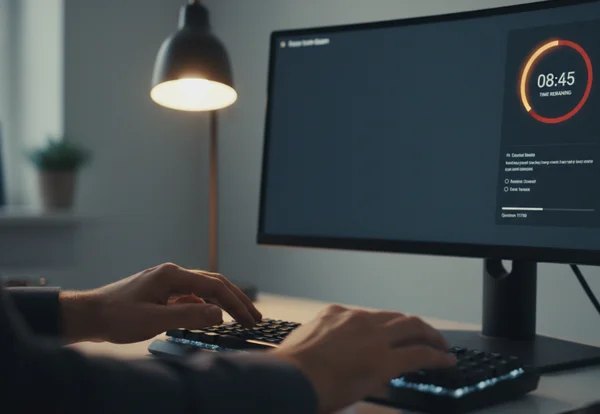
Typing is a complex fine motor skill that requires perfect coordination between your brain and your fingers. When you're relaxed, your "muscle memory" takes over. You don't think about where the "A" or "E" keys are; your fingers simply find them. However, adding pressure changes the chemical balance in your body, which can disrupt these automatic patterns.
The Psychological Impact of Time Pressure on Typing Performance
When you face a deadline or a timed test, your body often enters a "fight-or-flight" mode. This physiological response releases adrenaline and cortisol. While these chemicals help you run away from a predator, they're terrible for tasks requiring fine motor control. Your fingers may become stiff or develop slight tremors.
This physical tension makes it harder to maintain a smooth rhythm. Anxiety also disrupts your focus. Instead of looking at the words you need to type, your mind starts worrying about the remaining time or the consequences of failing. Research reveals a harsh truth: evaluation pressure slashes typing speeds by 15–30%. Why? Stress overrides muscle memory. By using a free wpm test, you can begin to expose yourself to this time pressure in a safe environment.
Cognitive Overload: When Your Brain Outpaces Your Fingers
Cognitive overload occurs when the demands placed on your working memory exceed its capacity. When you type, your brain does several things at once: reading the source text, translating those letters into finger movements, and monitoring the screen for errors. Under pressure, your brain tries to work faster than your hands can move.
This creates a bottleneck. Your brain races ahead, planning words three steps further. Meanwhile, your fingers lag behind, struggling to finish the current word. This disconnect leads to "transposition errors," where you type letters in the wrong order. To fix this, you must learn to align your mental processing speed with your physical capability. Measuring your current threshold with a customizable typing test is the first step toward managing this mental load.
Proven Techniques for Maintaining Accuracy Under Pressure
Improving your typing accuracy under stress isn't just about typing more. It's about training your nervous system to stay steady. By using specific psychological and physical strategies, you can maintain your wpm test scores even when the pressure is intense.
Breath Control and Rhythm Strategies for Typing
One of the fastest ways to calm your nervous system is through breath control. The 4-7-8 breathing method is highly effective: inhale for 4 seconds, hold for 7, and exhale for 8. Doing this before a high-stakes typing task lowers your heart rate and reduces finger tension.
Once you begin typing, try to find a rhythm. Professional typists often compare typing to playing the piano. Instead of bursts of extreme speed followed by pauses, aim for a steady, metronome-like pace. If you can synchronize your keystrokes to a consistent beat, you're much less likely to "choke" when the timer gets close to zero.
Progressive Exposure Drills for Building Typing Resilience
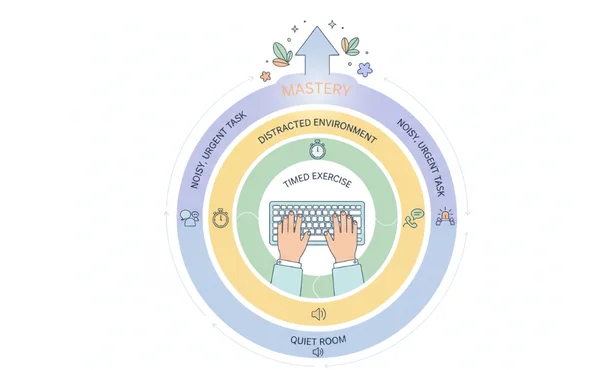
Resilience is built through "stress inoculation." This means exposing yourself to small amounts of pressure so that you become immune to it over time. Start by typing in a completely quiet room with no timer. Once you're comfortable, move to a timed typing test and set the duration for only one minute.
Gradually increase the difficulty. You can try typing in a slightly noisy environment or using more difficult vocabulary. The goal is to move from your "comfort zone" to a "challenge zone." Facing real pressure? Your brain will recognize the stress. Thanks to practice, you'll stay calm—just like a seasoned performer.
Error Prevention Strategies During High-Stakes Typing
In high-pressure situations, many people make the mistake of trying to type faster to "get it over with." This usually leads to more errors, which then causes more panic. A better strategy is the "strategic slow-down." When you reach a difficult word or a transition between sentences, intentionally slow down for a split second.
You should also develop an "error radar." This is the ability to feel a mistake the moment your finger hits the wrong key. Instead of panicking, acknowledge the error, correct it quickly, and return to your rhythm. To practice this, start your test and focus entirely on hitting a 100% accuracy rate, even if it means your speed is lower than usual.
Implementing Your Pressure-Proof Typing Routine
Knowledge is only useful if you put it into practice. To truly bulletproof your typing skills, you need a structured routine that specifically targets performance under stress. A consistent daily habit is more effective than one long practice session per week.
Custom WPMTest Pressure Scenarios
The best way to train is to use a tool that lets you customize your experience. On our platform, you can set up specific scenarios to challenge yourself. For example, you can use the custom text feature to paste in complex legal documents, medical terminology, or computer code.
Practicing with unfamiliar and difficult text forces your brain to stay alert. You can also vary the testing time. Try a 30-second sprint to test pure speed, then switch to a 5-minute endurance test to see how your accuracy holds up as you get tired. Try using different settings to identify your specific weak points.
Tracking Progress and Setting Realistic Goals
You can't improve what you don't measure. Keep a log of your scores, but don't just look at the WPM (Words Per Minute). Pay close attention to your accuracy percentage and your CPM (Characters Per Minute). If your accuracy is below 95%, you're typing too fast for your current skill level.
Set incremental goals. If your average speed under pressure is 50 WPM, don't try to hit 80 WPM immediately. Aim for 53 WPM with perfect accuracy. Small, consistent wins build the confidence necessary to handle high-stress environments. Check your current stats by taking a typing wpm test today.
Building Sustainable Typing Endurance
Endurance is often overlooked in typing. Many people can type fast for one minute, but their accuracy collapses after ten minutes. To build endurance, follow the 20-minute rule: practice for 20 minutes with high focus, then take a 5-minute break to stretch your hands and wrists.
Proper ergonomics also play a huge role in endurance. If your seat height is wrong or your wrists are strained, you'll fatigue faster, and fatigue leads to errors. Stay hydrated and ensure your workspace is comfortable. When your body feels good, your mind can focus better on the task at hand. You'll see your results improve over time as you build this physical and mental stamina.
Ready to type calmly under pressure?
Start by understanding why stress affects your typing. By practicing breath control and using progressive exposure drills, you'll turn anxiety into a competitive advantage. Remember that accuracy is the foundation of speed; a fast typist who makes mistakes is actually slower than a steady typist who is 100% accurate.
Real-World Tip: Simulate stress before high-stakes moments using simulated environments. Use the tools available to you to track your progress and build your confidence. Test your WPM today and see how you handle the clock. With consistent effort, you'll find that "choking" becomes a thing of the past, and you can type with confidence in any situation.

FAQ Section
What is a good WPM score under pressure?
A "good" score depends on your profession. For most office jobs, 60-70 WPM with 95% accuracy is considered very good under pressure. For specialized roles like legal transcription or programming, you may need 80-90 WPM. The most important factor is consistency. If your speed drops by more than 10% during a test, you should focus more on stress-management techniques.
How can I test my typing speed and accuracy in stressful conditions?
The best way is to use a typing test and add your own "stressors." You can set a strict time limit, ask a friend to watch you type, or even play loud music to simulate a busy office. Using a "custom text" feature to type difficult material is also an excellent way to simulate the pressure of a real-world task.
How is WPM calculated during timed tests with error correction?
WPM is usually calculated by taking the total number of characters typed, dividing by 5 (the average word length), and then dividing by the number of minutes. Most modern tests, including the one at our test tool, account for accuracy. In some "Net WPM" calculations, errors are subtracted from your total, which is why maintaining high accuracy is so vital for a high final score.
What is the average typing speed drop under pressure?
Most unpracticed typists see a performance decrease of about 15% to 30% when they feel stressed. This is often due to muscle tension and "cognitive interference," where the brain worries about the results instead of the task. However, with regular typing practice, you can reduce this drop to less than 5%, or even perform better under pressure as you learn to use the adrenaline to your advantage.